

 Image 1 of 1
What It Is
MOTS-c is a 16 amino acid peptide that your mitochondria actually produce naturally. Unlike most peptides that are synthetic versions of hormones, MOTS-c is encoded directly in your mitochondrial DNA. Your body makes it in response to stress and exercise, and it helps regulate how your cells use energy.
The peptide was discovered in 2015 by researchers studying the mitochondrial genome. They found that when MOTS-c levels increase, it improves how your body handles glucose, enhances insulin sensitivity, and appears to slow certain aspects of aging. In animal studies, MOTS-c prevented diet induced obesity and reversed insulin resistance even in older subjects.
The interesting thing about MOTS-c is that your natural levels decline with age. This decline correlates with the metabolic dysfunction that comes with getting older: worse insulin sensitivity, more difficulty burning fat, less energy, and reduced physical capacity. Supplementing with exogenous MOTS-c may help restore some of what time takes away.
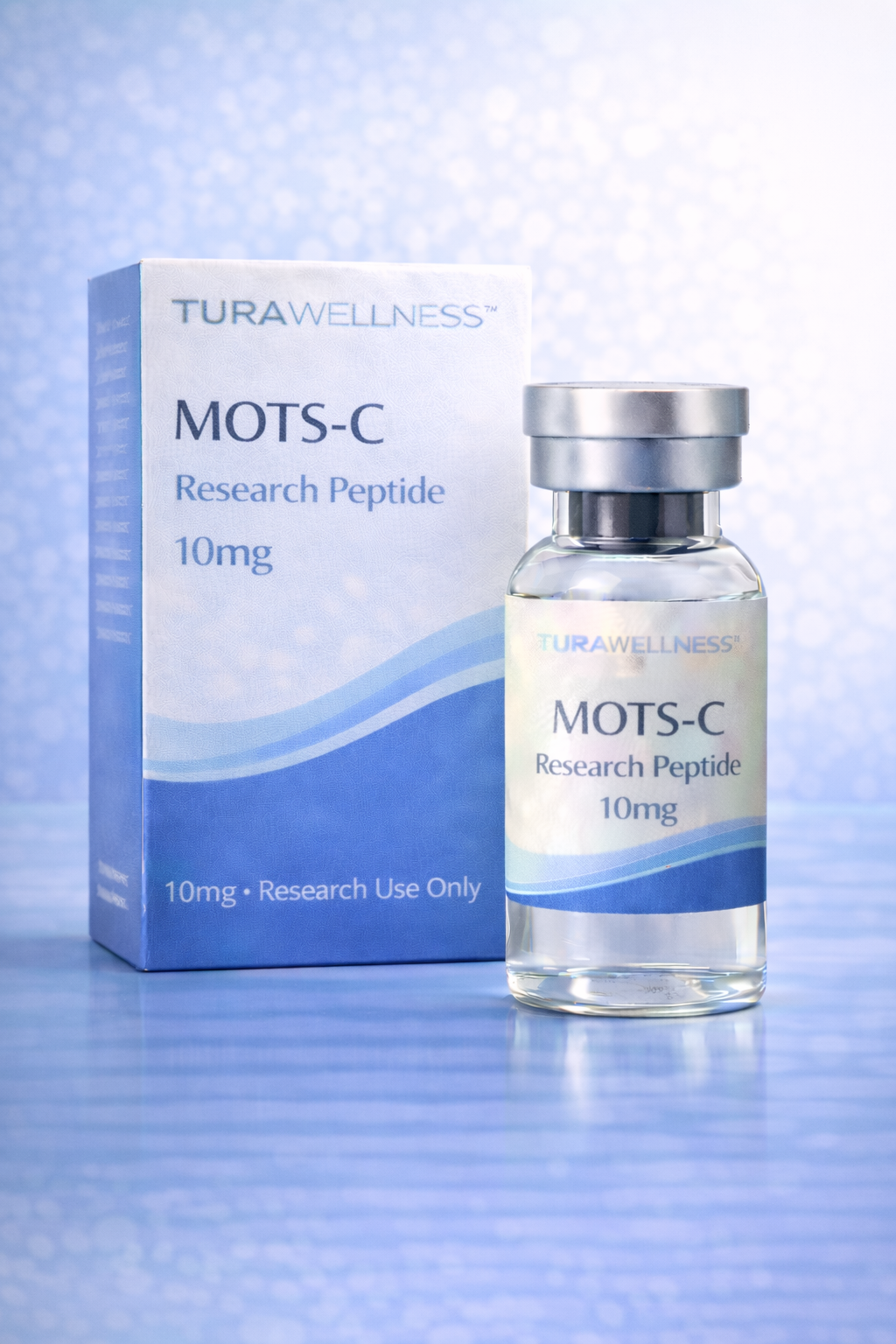
MOTS-c is available through research peptide suppliers. It has not undergone large scale human clinical trials, though a related compound (CB4211) has shown safety in early human studies.
How It Works
MOTS-c works through a pathway called AMPK activation. AMPK is often described as your cellular energy sensor. When AMPK is activated, your cells shift toward burning fat for fuel, taking up glucose more efficiently, and producing new mitochondria.
The AMPK Connection
When you inject MOTS-c, it enters your cells and inhibits the folate cycle, which is connected to purine biosynthesis. This creates a kind of metabolic stress signal that activates AMPK. The result is similar to what happens when you exercise or fast: your cells become more metabolically flexible and efficient.
Nuclear Translocation
What makes MOTS-c unusual is that it can move from the cytoplasm into the nucleus under stress conditions. Once there, it directly regulates gene expression, particularly genes involved in the antioxidant response. This means MOTS-c is not just a metabolic signal. It is actually changing which genes get turned on.
Skeletal Muscle Targeting
The primary target tissue appears to be skeletal muscle. In studies, MOTS-c enhanced glucose uptake in muscle tissue, improved insulin sensitivity specifically in muscle, and helped muscle cells adapt to metabolic stress. This makes sense given that exercise naturally increases MOTS-c expression in muscle.
Exercise Mimetic Effects
Exercise increases your natural MOTS-c levels by about 12 fold. Researchers have described MOTS-c as an exercise mimetic because supplementing with it produces some of the same metabolic benefits as exercise: improved glucose handling, enhanced fat oxidation, and better physical performance.
Benefits
Improved Insulin Sensitivity
This is the most well documented effect. In animal studies, MOTS-c treatment reversed diet induced insulin resistance and improved glucose tolerance. The effect was significant even in older animals.
Prevention of Diet Induced Obesity
Mice treated with MOTS-c while eating a high fat diet gained significantly less weight than untreated controls. The compound appears to enhance fat burning and prevent the metabolic dysfunction that comes with overfeeding.
Enhanced Physical Performance
In one study, MOTS-c treatment improved physical performance in young, middle aged, and old mice. Even when treatment started late in life (the equivalent of roughly 70 human years), mice showed improved running capacity and muscle function.
Potential Anti-Aging Effects
MOTS-c levels decline with age, and this decline correlates with worsening metabolic function. Restoring MOTS-c levels in older animals improved markers associated with healthy aging. Researchers have proposed it as a potential longevity intervention.
Cardiovascular Benefits
Animal studies show MOTS-c improves cardiac function, reduces damage from type 2 diabetes, and enhances the cardiovascular benefits of exercise.
Reduced Inflammation
MOTS-c downregulates inflammatory cytokines including IL-6, IL-1β, and TNF-α. Chronic inflammation is a driver of metabolic disease and aging, so this effect may contribute to the broader health benefits.
Bone Health
Recent research shows MOTS-c promotes osteoblast proliferation and inhibits osteoclast production, suggesting potential benefits for bone metabolism.
What the Science Shows
MOTS-c has substantial preclinical data but limited human evidence.
Initial Discovery Study (2015)
Published in Cell Metabolism by Lee et al. This landmark paper identified MOTS-c and demonstrated that it regulates insulin sensitivity and metabolic homeostasis in mice. Treatment prevented both age dependent and high fat diet induced insulin resistance, as well as diet induced obesity.
Exercise and Physical Performance Study (2021)
Published in Nature Communications. Researchers showed that MOTS-c is an exercise induced peptide that regulates skeletal muscle metabolism. Treatment improved physical performance in mice of all ages. Late life initiated treatment (starting at 23.5 months, equivalent to roughly 70 human years) improved physical capacity and healthspan. In humans, exercise was shown to induce endogenous MOTS-c expression in skeletal muscle and circulation.
Bone Metabolism Research (2023)
Published in Frontiers in Physiology. MOTS-c was shown to promote osteoblast proliferation, differentiation, and mineralization while inhibiting osteoclast production. This suggests potential applications for bone health and osteoporosis.
CB4211 Human Safety Data
CB4211 is a synthetic analog of MOTS-c. A Phase 1a/1b double blind, placebo controlled trial in healthy adults found it safe and well tolerated. This provides some human safety signal, though CB4211 is not identical to MOTS-c.
Diabetes and Pancreatic Function (2025)
Recent research published in Experimental & Molecular Medicine showed that MOTS-c treatment reduced signs of aging in pancreatic cells and improved their function. MOTS-c levels are lower in type 2 diabetes patients compared to healthy controls.
Sources:
• Lee et al. "The Mitochondrial-Derived Peptide MOTS-c Promotes Metabolic Homeostasis and Reduces Obesity and Insulin Resistance." Cell Metabolism (2015)
• Reynolds et al. "MOTS-c is an exercise-induced mitochondrial-encoded regulator of age-dependent physical decline and muscle homeostasis." Nature Communications (2021)
• Wan et al. "Mitochondria-derived peptide MOTS-c: effects and mechanisms related to stress, metabolism and aging." Journal of Translational Medicine (2023)
Dosing Protocol
MOTS-c dosing is less established than other peptides because human clinical trials are limited. Understanding the different protocols and their rationale will help you choose an approach.
Understanding the Dose Approaches
You will see MOTS-c protocols ranging from 200 mcg daily to 10 mg every few days. This wide variation exists because different users have different goals and because we are extrapolating from animal research without solid human dose-response data.
Exercise Mimetic vs Metabolic Treatment
MOTS-c functions as an exercise mimetic. It activates AMPK and produces metabolic effects similar to endurance exercise. How you use it depends on what you are trying to accomplish.
If you exercise regularly and want MOTS-c to enhance your existing training: Lower doses (200 to 500 mcg daily or 5 mg weekly) may complement your activity without overshadowing it. Think of this as a training enhancer.
If you have metabolic dysfunction or cannot exercise adequately: Higher doses (5 to 10 mg every few days) may help compensate for reduced physical activity. The animal studies showing dramatic metabolic improvements used relatively high doses in sedentary or obese animals.
If you are using MOTS-c for general longevity and metabolic support: Moderate intermittent protocols (5 mg every 5 days) provide periodic metabolic activation without continuous exposure.
The Animal to Human Translation Problem
Animal studies used 5 to 15 mg/kg doses. A simple weight-based conversion would suggest extremely high human doses. However, metabolic scaling between species suggests human equivalent doses are roughly 10 fold lower. The commonly used 5 to 10 mg human dose is a conservative starting point, but optimal human dosing remains unclear.
Matching Protocol to Situation
Training enhancement (active exerciser): 200 to 500 mcg daily or 5 mg weekly in split doses. Use on training days. Lower doses allow your own exercise adaptations to dominate.
Metabolic support (insulin resistance, obesity): 5 to 10 mg every 5 days or weekly. Higher doses for more aggressive metabolic intervention.
Longevity and general wellness: 5 mg every 5 days for 20 day cycles, repeated several times per year. Intermittent exposure rather than continuous.
Standard Protocols
Human clinical trial data is lacking, so dosing is extrapolated from animal studies and community experience. The protocols below represent common approaches.
Subcutaneous injection.
Standard Protocol:
• 5 mg every 5 days
• 20 day cycle (4 injections total)
• Repeat cycle 2 to 4 times per year
Weekly Protocol:
• 5 to 10 mg per week
• Split into 2 to 3 injections (example: Monday, Wednesday, Friday)
• 2 to 4 week cycles followed by equal time off
Daily Low Dose Protocol:
• 200 to 500 mcg daily
• Titrate up gradually over several weeks
• 8 to 12 week cycles
Important Notes:
Morning dosing on an empty stomach is typical. This mimics the natural increase in MOTS-c that occurs during fasting and may enhance fat oxidation throughout the day.
Some users report better results when dosing before exercise, particularly fasted cardio.
Animal studies used doses of 5 to 15 mg/kg intraperitoneally or subcutaneously. Human equivalent doses would be roughly 10 fold lower. The standard 5 to 10 mg human dose is conservative extrapolation.
Draw Volumes by Vial Size
All calculations assume reconstitution volumes that provide practical measurements on a standard insulin syringe.
5 mg Vial (1 mL reconstitution = 5 mg/mL)
Dose Volume Units on Syringe
──────────────────────────────────────────
1 mg 0.20 mL 20 units
2.5 mg 0.50 mL 50 units
5 mg 1.00 mL 100 units (full syringe)
Vial duration at 5 mg weekly: 1 week
10 mg Vial (2 mL reconstitution = 5 mg/mL)
Dose Volume Units on Syringe
──────────────────────────────────────────
1 mg 0.20 mL 20 units
2.5 mg 0.50 mL 50 units
5 mg 1.00 mL 100 units
Vial duration at 5 mg weekly: 2 weeks
Vial duration at 5 mg every 5 days: approximately 2 weeks
10 mg Vial (1 mL reconstitution = 10 mg/mL)
Dose Volume Units on Syringe
──────────────────────────────────────────
1 mg 0.10 mL 10 units
2.5 mg 0.25 mL 25 units
5 mg 0.50 mL 50 units
10 mg 1.00 mL 100 units
Vial duration at 5 mg weekly: 2 weeks
This is a more concentrated solution that works well if you prefer smaller injection volumes.
Reconstitution Instructions
1. Draw the appropriate amount of bacteriostatic water into a sterile syringe (1 to 2 mL depending on vial size and desired concentration)
2. Inject slowly down the inside wall of the vial to avoid foaming
3. Gently swirl or roll the vial until fully dissolved. Do not shake.
4. Solution should be clear and colorless. Do not use if cloudy or contains particles.
5. Label with reconstitution date and concentration
6. Refrigerate at 36 to 46 degrees Fahrenheit (2 to 8 degrees Celsius)
7. Use within 7 days for optimal potency (some sources say 28 days is acceptable with proper storage)
Side Effects and Cautions
MOTS-c is naturally produced by your body, which may contribute to its favorable safety profile. Reported side effects are generally mild.
Potential Effects:
• Injection site reactions (redness, swelling, mild bruising)
• Mild fatigue or lethargy when first starting (your body adjusting to AMPK activation)
• Changes in appetite (some report suppression, others increased hunger)
• Possible sleep disturbance if dosed late in day
Less Common:
• Headache
• Mild GI discomfort
What We Do Not Know:
MOTS-c has not undergone large scale human safety trials. Long term effects are unknown. There are theoretical concerns about cancer risk because MOTS-c may affect cell proliferation pathways. Some research suggests it could be therapeutic for cancer, while other studies raise concerns about promoting certain cancer types. If you have active cancer or a history of cancer, avoid this compound unless advised otherwise by a physician.
When to Contact a Medical Professional:
• Signs of allergic reaction (rash, swelling, difficulty breathing)
• Persistent or severe symptoms
• Any unusual health changes
Who Should Avoid or Use With Care
Use with caution if you have:
• Active cancer or history of cancer
• Type 1 diabetes (not studied in this population)
• Any serious chronic illness
Drug Interactions:
No formal drug interaction studies exist. MOTS-c affects glucose metabolism, so if you take diabetes medications, monitor blood sugar closely and adjust as needed.
Pregnancy and Breastfeeding:
Not studied. Avoid use.
Athletes:
MOTS-c is on the WADA prohibited list. If you compete in tested sports, do not use this compound.
Success Tips
Timing Matters
Morning dosing on an empty stomach is most common. This aligns with your body's natural fasting state and may enhance metabolic effects. Some users dose before fasted cardio to maximize fat oxidation.
Pair It With Exercise
MOTS-c is described as an exercise mimetic, but that does not mean it replaces exercise. The research suggests it amplifies the benefits of training. Think of it as making your workouts more effective, not as a substitute for them.
Stack Strategically
MOTS-c works through mitochondrial and AMPK pathways. It can be combined with compounds that work through different mechanisms. Some users stack it with GH secretagogues or other metabolic compounds, though research on combinations is limited.
Track Metabolic Markers
If you have access to bloodwork, tracking fasting glucose, HbA1c, and insulin levels before and after a cycle can help you assess response.
Be Patient
The effects of MOTS-c are metabolic optimization, not dramatic overnight changes. Give it time to work. The animal studies showing improved physical performance and insulin sensitivity ran for weeks.
Maintain the Basics
MOTS-c enhances metabolic function, but it does not override poor diet or lack of exercise. Use it alongside solid nutrition and consistent training for best results.
Need Help With Nutrition or Training?
Peptides work best when paired with solid nutrition and training protocols. If you want structured guidance on metabolic health, fat loss, or building a training program that supports your goals, check out our website at: turawellness.com
Injection Technique
1. Wash hands thoroughly with soap and water
2. Clean the vial stopper with an alcohol swab and allow to air dry
3. Draw the appropriate dose into a sterile insulin syringe
4. Clean the injection site with an alcohol swab
5. Pinch a skinfold and insert the needle at 45 to 90 degrees into subcutaneous tissue
6. Do not aspirate for subcutaneous injections
7. Inject slowly and steadily
8. Withdraw needle and apply light pressure with gauze if needed
9. Dispose of syringe immediately in a sharps container. Never recap needles.
10. Rotate injection sites (abdomen, thighs, upper arms) at least 1 inch apart
Storage and Handling
Before Reconstitution:
• Store lyophilized (powder) vials in the freezer at minus 4 degrees Fahrenheit (minus 20 degrees Celsius)
• Can also be stored in the refrigerator at 36 to 46 degrees Fahrenheit
• Protect from light and moisture
• Do not use past expiration date
After Reconstitution:
• Refrigerate at 36 to 46 degrees Fahrenheit
• Use within 7 days for optimal potency
• Do not freeze after reconstitution
• Keep the stopper clean
• If solution becomes cloudy or contains particles, discard and use a new vial
Comparison to Other Metabolic Compounds
Compound Mechanism Primary Effect Human Data
──────────────────────────────────────────────────────────────────────────────────────────────
MOTS-c AMPK activation Metabolic optimization Limited
Tirzepatide GLP-1 + GIP Appetite + metabolism Extensive
Semaglutide GLP-1 Appetite suppression Extensive
AOD-9604 Beta-3 adrenergic Fat burning Moderate
5-Amino-1MQ NNMT inhibition Fat metabolism Limited
MOTS-c works through a fundamentally different pathway than the incretin drugs. It does not suppress appetite the way GLP-1 agonists do. Instead, it optimizes how your cells handle energy at the mitochondrial level. This makes it potentially complementary to other approaches rather than a direct alternative.
Legal Status
United States: Not FDA approved. Available through research peptide suppliers.
WADA Status: Prohibited in competitive sports.
Research Status: Preclinical data is strong. CB4211 (a related analog) has undergone Phase 1 human safety trials.
Frequently Asked Questions
How is MOTS-c different from other fat loss peptides?
MOTS-c works at the mitochondrial level through AMPK activation. It does not suppress appetite like GLP-1 drugs and does not target fat cells directly like adipotide. It improves how your cells use energy overall.
Is it the same as exercise?
No. MOTS-c is described as an exercise mimetic because it triggers some of the same metabolic pathways exercise does. But exercise provides many benefits beyond what any single compound can replicate. MOTS-c may amplify the benefits of training, not replace it.
Why do levels decline with age?
This is not fully understood. Mitochondrial function declines with age, and MOTS-c production appears to follow that decline. Restoring levels may help counteract some aspects of metabolic aging.
Can I combine it with GLP-1 drugs?
There is no research on this specific combination. MOTS-c works through different mechanisms than GLP-1 agonists, so theoretically they could be complementary. But this is speculative.
Will it help me lose weight?
Animal studies show it prevents diet induced obesity and improves metabolic markers. Whether this translates to meaningful weight loss in humans who are not eating a controlled laboratory diet is unknown. Do not expect it to produce the dramatic results seen with tirzepatide or semaglutide.
Is it safe long term?
Unknown. Large scale human safety data does not exist. The fact that MOTS-c is naturally produced by your body is encouraging, but exogenous supplementation may have different effects than endogenous production.
Product Source
Research Grade MOTS-c available at: turawellness.com
Disclaimer
This guide provides educational information about MOTS-c based on published scientific literature and preclinical data. This is for educational purposes only and does not constitute medical advice, diagnosis, or treatment. MOTS-c is a research compound that has not been approved by the FDA. Always consult qualified healthcare professionals before using any peptide or medication.
References
1. Lee C, et al. "The Mitochondrial-Derived Peptide MOTS-c Promotes Metabolic Homeostasis and Reduces Obesity and Insulin Resistance." Cell Metabolism (2015)
2. Reynolds JC, et al. "MOTS-c is an exercise-induced mitochondrial-encoded regulator of age-dependent physical decline and muscle homeostasis." Nature Communications (2021)
3. Wan W, et al. "Mitochondria-derived peptide MOTS-c: effects and mechanisms related to stress, metabolism and aging." Journal of Translational Medicine (2023)
4. Kim KH, et al. "The mitochondrial-encoded peptide MOTS-c translocates to the nucleus to regulate nuclear gene expression in response to metabolic stress." Cell Metabolism (2018)
5. Kong BS, et al. "Mitochondrial-encoded peptide MOTS-c prevents pancreatic islet cell senescence to delay diabetes." Experimental & Molecular Medicine (2025)
6. Singh MK, et al. "MOTS-c, the Most Recent Mitochondrial Derived Peptide in Human Aging and Age-Related Diseases." International Journal of Molecular Sciences (2022)