

 Image 1 of 1
What It Is
Tesamorelin is a synthetic form of growth hormone releasing hormone (GHRH). It consists of 44 amino acids that match the full sequence of natural human GHRH, with one important modification: a trans-3-hexenoic acid group attached to the tyrosine at the N-terminus. This modification makes tesamorelin more stable and resistant to breakdown by the enzyme dipeptidyl aminopeptidase 4 (DPP-4).
The FDA approved tesamorelin in 2010 under the brand name Egrifta for a specific indication: reducing excess abdominal fat in adults with HIV who have lipodystrophy. It remains the only medication specifically approved for this condition. A newer formulation called Egrifta WR was approved in 2024, offering weekly reconstitution instead of daily.
Tesamorelin was developed by Theratechnologies, Inc. of Canada. Beyond its approved use, researchers have studied it for conditions including obesity, nonalcoholic fatty liver disease (NAFLD), insulin resistance, and cognitive function in older adults.
Unlike direct growth hormone injections, tesamorelin works by stimulating the pituitary gland to produce and release its own growth hormone. This approach preserves the natural pulsatile pattern of GH secretion and maintains physiological feedback mechanisms. The result is a more natural hormone profile compared to exogenous GH administration.
Tesamorelin is a controlled medication requiring a prescription. It is prohibited by the World Anti-Doping Agency (WADA) under the category of Peptide Hormones, Growth Factors, and Related Substances.
Important Context: CJC-1295 Equivalence
CJC-1295 (also called Mod GRF 1-29) is structurally nearly identical to tesamorelin. Both are GHRH analogs that work through the same mechanism: binding GHRH receptors on the pituitary to stimulate natural growth hormone release.
The key difference is not effectiveness but FDA approval pathway. Tesamorelin was developed and studied specifically for HIV lipodystrophy, using visceral fat reduction as the primary endpoint. CJC-1295 was positioned for general GH optimization and studied with different metrics.
This does not mean tesamorelin reduces visceral fat better than CJC-1295. The same mechanism produces the same downstream effects. CJC-1295 achieves equivalent results at significantly lower cost.
When choosing between them:
Tesamorelin costs more and has FDA approval (relevant for some medical contexts)
CJC-1295 costs less and is equally effective for GH optimization and body composition
Both work best when combined with a ghrelin mimetic like Ipamorelin
How It Works
Tesamorelin works by binding to GHRH receptors on somatotroph cells in the anterior pituitary gland. When these receptors are activated, they trigger a signaling cascade that results in the synthesis and release of endogenous growth hormone.
The released growth hormone then circulates through the body and acts on target cells including adipocytes (fat cells), hepatocytes (liver cells), myocytes (muscle cells), and osteoblasts (bone cells). One of its most important effects is stimulating the liver to produce insulin like growth factor 1 (IGF-1).
The fat loss mechanism of tesamorelin involves two primary processes. First, growth hormone directly promotes lipolysis, the breakdown of stored triglycerides into free fatty acids. Second, the resulting elevation in IGF-1 supports improved body composition and metabolic function. Research indicates tesamorelin particularly targets visceral adipose tissue, the deep abdominal fat that surrounds internal organs and is associated with metabolic disease.
Unlike exogenous growth hormone, tesamorelin preserves the pulsatile pattern of GH release. The pituitary still responds to normal feedback mechanisms, including inhibition by somatostatin. This means the body maintains regulatory control over hormone levels rather than being overwhelmed by constant supraphysiologic doses.
Tesamorelin has a half-life of approximately 1 hour. After subcutaneous administration, GH levels begin rising and remain elevated for several hours. Consistent daily dosing maintains elevated baseline GH and IGF-1 levels throughout a treatment period.
Benefits
Visceral Fat Reduction
Clinical trials demonstrate tesamorelin reduces visceral adipose tissue by approximately 15 to 20 percent over 26 weeks. This effect specifically targets the deep abdominal fat most associated with cardiovascular and metabolic disease risk. CJC-1295 achieves the same result through the same mechanism.
Preservation of Lean Mass
While reducing fat, tesamorelin helps preserve lean body mass. This makes it valuable during cutting phases or caloric restriction when muscle loss is a concern. Growth hormone promotes protein synthesis and opposes the catabolic effects of dieting.
Improved Lipid Profile
Studies show tesamorelin improves triglyceride levels and the ratio of total cholesterol to HDL cholesterol. These changes may reduce cardiovascular risk factors associated with excess visceral fat.
Liver Health Support
Research in patients with nonalcoholic fatty liver disease shows tesamorelin reduces hepatic fat content by approximately 37 percent. It may also prevent progression of liver inflammation and fibrosis. This represents a promising application beyond its approved indication.
Natural Hormone Stimulation
By working through the body's own GHRH receptors, tesamorelin maintains physiological feedback mechanisms. This results in more natural GH pulsatility compared to direct growth hormone injections.
Enhanced Recovery
Elevated GH and IGF-1 support collagen turnover, joint integrity, and soft tissue repair. Athletes and active individuals may experience improved recovery from training and injury.
Cognitive Function
Preliminary research suggests tesamorelin may improve executive function, working memory, and response inhibition in older adults, including those with mild cognitive impairment.
Body Image Improvement
Clinical trials report improved body image distress scores in patients using tesamorelin, reflecting the psychological benefits of improved body composition.
What the Science Shows
Falutz et al. (2010): Phase III HIV Lipodystrophy Trial
Published in the Journal of Acquired Immune Deficiency Syndromes. This pivotal study evaluated tesamorelin in 404 HIV-infected patients with excess abdominal fat.
Results:
• Tesamorelin reduced visceral adipose tissue by approximately 18 percent compared to placebo
• Improvements occurred without significant perturbation of glucose metabolism
• Body image distress scores improved significantly
• Effects reversed when treatment was discontinued
Grunfeld et al. (2007): NEJM Metabolic Effects Study
Published in the New England Journal of Medicine. Researchers assessed 412 HIV patients receiving either 2 mg tesamorelin or placebo daily for 26 weeks.
Results:
• Tesamorelin significantly decreased visceral adiposity
• Triglyceride levels improved
• The ratio of total cholesterol to HDL cholesterol improved
• IGF-1 levels increased appropriately
• Overall glucose tolerance was not worsened
Stanley et al. (2019): NAFLD Trial
Published in JAMA. This randomized, double-blind multicenter trial examined tesamorelin in people with HIV and nonalcoholic fatty liver disease.
Results:
• Tesamorelin reduced hepatic fat fraction by 37 percent (absolute reduction of 4.1%)
• Liver fibrosis progression was prevented compared to placebo
• More participants on tesamorelin showed histological improvement
• Benefits maintained over 12 months of treatment
Vilar-Gomez et al. (2014): Body Composition Analysis
Published in JAMA. This study analyzed detailed body composition changes with tesamorelintherapy.
Results:
• Visceral fat decreased by 15 to 17 percent
• Liver fat decreased by up to 18 percent
• Lean body mass was preserved
• Trunk fat showed significant reductions
Note on Research Context
These studies measured tesamorelin specifically because that is what the manufacturer was seeking FDA approval for. CJC-1295 works through the same receptor and mechanism. The lack of equivalent FDA trials for CJC-1295 reflects commercial development decisions, not differences in effectiveness.
Sources:
Dosing Protocol
Standard Protocol (FDA-Approved)
Dose: 2 mg (2000 mcg) per day
Frequency: Once daily, subcutaneous injection
Timing: Evening, at least 90 minutes after the last meal (before bedtime aligns with natural GH release)
Cycle Length: Continuous use in clinical trials; 20 to 52 weeks studied
Alternative Protocol
Dose: 1 to 2 mg per day
Frequency: 5 days on, 2 days off (some practitioners use this approach)
Cycle Length: 60 to 90 days, followed by a 30-day break
This cycling approach may reduce costs and allow for periodic reassessment.
Combined Protocol With Ipamorelin
Dose: 1 to 2 mg Tesamorelin before bed plus 100 to 200 mcg Ipamorelin in the morning or pre-workout
Frequency: Daily, 5 days per week
Cycle Length: 60 to 90 days
This combination targets GH release through two different pathways.
Important Notes
• Inject into the abdominal area below the navel
• Rotate injection sites
• Do not inject into scarred, bruised, or irritated areas
• Administer at the same time each day for consistent results
• Monitor IGF-1 levels periodically under medical supervision
Draw Volumes by Vial Size
Use an insulin syringe marked in units. 100 units equals 1 mL.
**5 mg Vial (2.5 mL reconstitution = 2 mg/mL)**
Dose Volume Units on Syringe
───────────────────────────────────────────
1 mg 0.50 mL 50 units
1.5 mg 0.75 mL 75 units
2 mg 1.00 mL 100 units
Vial duration at 2 mg daily: 2.5 days
**5 mg Vial (2 mL reconstitution = 2.5 mg/mL)**
Dose Volume Units on Syringe
───────────────────────────────────────────
1 mg 0.40 mL 40 units
1.5 mg 0.60 mL 60 units
2 mg 0.80 mL 80 units
Vial duration at 2 mg daily: 2.5 days
**5 mg Vial (1 mL reconstitution = 5 mg/mL)**
Dose Volume Units on Syringe
───────────────────────────────────────────
1 mg 0.20 mL 20 units
1.5 mg 0.30 mL 30 units
2 mg 0.40 mL 40 units
Vial duration at 2 mg daily: 2.5 days
Reconstitution
Materials Needed:
• Peptide vial (lyophilized powder)
• Bacteriostatic water
• Sterile syringe for reconstitution
• Alcohol swabs
Instructions:
1. Wipe the vial stopper and bacteriostatic water vial with alcohol swabs
2. Draw the desired volume of bacteriostatic water into a sterile syringe
3. Insert needle through rubber stopper at an angle
4. Let water trickle down the inside wall of the vial slowly
5. Do not inject directly onto the powder
6. Swirl gently until fully dissolved (do not shake)
7. Solution should be clear and colorless. If cloudy or contains particles, do not use
The reconstituted solution should be used promptly or stored according to peptide guidelines. The newer Egrifta WR formulation allows for weekly reconstitution.
Side Effects
Common:
• Injection site reactions: Redness, swelling, pain, itching, or irritation at the injection site
• Joint pain (arthralgia): Mild to moderate joint discomfort
• Muscle pain (myalgia): Generally temporary
• Peripheral edema: Mild fluid retention, particularly in extremities
• Paresthesia: Numbness or tingling sensations
Metabolic Effects:
• Elevated IGF-1 levels: Requires monitoring during treatment
• Glucose intolerance: May increase blood sugar in some individuals
• Increased risk of type 2 diabetes: Particularly in those predisposed
Rare:
• Hypersensitivity reactions: Rash, hives, difficulty breathing (discontinue if these occur)
• Carpal tunnel syndrome: Related to fluid retention
• Headache
Long-Term Considerations: Tesamorelin raises IGF-1 levels, which theoretically could stimulate growth of existing tumors. Individuals with a history of cancer should not use tesamorelin. Clinical trials have not shown increased cancer incidence, but caution is warranted.
Contraindications and Precautions
Do Not Use If You Have:
• Active cancer or history of any malignant tumor
• Pituitary gland disorders, surgery, or tumors
• History of radiation therapy to the head or brain
• Known hypersensitivity to tesamorelin or related compounds
• Pregnancy (FDA Pregnancy Category X: can harm the fetus)
Use Caution With:
• Diabetes or prediabetes (monitor blood glucose closely)
• History of head injury or trauma
• Kidney or liver disease
• Heart disease or recent heart surgery
• Breathing problems or asthma
• Migraines or epilepsy
• Adrenal gland disorders
Drug Interactions:
• Other growth hormone products: Do not combine
• Estrogen therapy: May affect response
• Glucocorticoids: May counteract effects
• Insulin and diabetes medications: May require dose adjustments
Special Populations:
• Not studied in children; not recommended for those under 18
• Women should not breastfeed while using tesamorelin
• HIV-infected women should not breastfeed regardless
Comparison Table
Feature Tesamorelin Sermorelin HGH 191AA
─────────────────────────────────────────────────────────────
Amino Acids 44 + hexenoyl 29 191
Mechanism GHRH analog GHRH fragment Direct GH
FDA Approved Yes (HIV lipo) Was approved Yes
Half-Life ~1 hour ~10 to 20 min ~3 to 4 hours
Dosing 2 mg daily 200 to 500 mcg 1 to 4 IU
Primary Use Visceral fat Anti-aging Multiple
Cost Higher Moderate Higher
Natural Pattern Yes Yes No
Success Tips
Administer Before Bed
Tesamorelin works best when injected in the evening, aligning with the body's natural growth hormone release during sleep. Wait at least 90 minutes after eating.
Be Patient With Results
Clinical trials show significant fat reduction by 26 weeks. Expect gradual, steady progress rather than dramatic overnight changes. The first noticeable improvements often appear around 8 to 12 weeks.
Monitor Your Metrics
Track waist circumference, body composition, and how clothes fit rather than relying solely on scale weight. Visceral fat loss may not translate directly to pounds lost if lean mass is preserved.
Maintain Consistent Dosing
The short half-life of tesamorelin requires daily administration for consistent results. Missing doses reduces effectiveness. Set a daily reminder.
Combine With Proper Nutrition
Tesamorelin supports fat loss but works best with a controlled diet. Focus on adequate protein intake and moderate caloric restriction for optimal body composition changes.
Consider IGF-1 Monitoring
Periodic blood tests for IGF-1 levels help ensure the therapy is working and that levels remain within safe ranges. Work with a healthcare provider familiar with peptide therapy.
Stack Strategically
Tesamorelin pairs well with Ipamorelin, which works through the ghrelin receptor rather than GHRH receptors. This combination targets GH release through complementary pathways.
Expect Rebound Without Maintenance
Clinical data shows visceral fat can return when tesamorelin is discontinued. Long-term or cyclical use may be necessary to maintain results.
Need Help With Training or Nutrition?
Peptides work best when paired with proper training and nutrition. If you want structured guidance, check out our website at turawellness.com
Injection Technique
1. Wash hands thoroughly with soap and water
2. Clean the vial stopper with an alcohol swab and allow to air dry
3. Draw the appropriate dose into a sterile insulin syringe
4. Clean the injection site (lower abdomen, below the navel) with an alcohol swab
5. Pinch a skinfold and insert the needle at 45 to 90 degrees into subcutaneous tissue
6. Inject slowly and steadily
7. Withdraw needle and apply light pressure with gauze if needed
8. Dispose of syringe immediately in a sharps container. Never recap needles.
9. Rotate injection sites at least 1 inch apart
10. Do not inject into the navel, scarred areas, or skin with redness or irritation
Storage and Handling
Before Reconstitution:
• Store lyophilized (powder) vials in the refrigerator at 36 to 46 degrees Fahrenheit
• Can also be stored in the freezer at minus 4 degrees Fahrenheit (minus 20 degrees Celsius) for longer periods
• Protect from light
• Do not use past expiration date
After Reconstitution:
• Refrigerate at 36 to 46 degrees Fahrenheit
• Use within 14 days (or according to specific product instructions)
• Do not freeze after reconstitution
• Keep the stopper clean
• If solution becomes cloudy or contains particles, discard
Legal Status
United States: Tesamorelin is FDA-approved under the brand names Egrifta SV and Egrifta WR for the reduction of excess abdominal fat in HIV-infected adults with lipodystrophy. It is a prescription medication. Off-label use for other conditions occurs but is not FDA-sanctioned.
World Anti-Doping Agency (WADA): Tesamorelin is prohibited at all times under Section S2: Peptide Hormones, Growth Factors, Related Substances, and Mimetics.
Competitive Athletes: Any athlete subject to drug testing should not use tesamorelin. GHRH and its analogs are banned substances.
Frequently Asked Questions
Is tesamorelin better than CJC-1295 for visceral fat?
No. Tesamorelin and CJC-1295 work through the same mechanism with equivalent effectiveness. The FDA approval for tesamorelin used visceral fat as the primary endpoint in HIV patients because that was the commercial development path. This does not mean tesamorelin is superior for visceral fat. CJC-1295 achieves the same results at lower cost.
Is tesamorelin only for HIV patients?
Tesamorelin is FDA-approved only for HIV-associated lipodystrophy. However, research continues in other conditions including NAFLD, general obesity, and cognitive decline. Some practitioners prescribe it off-label for these conditions.
How is tesamorelin different from direct HGH injections?
Tesamorelin stimulates your pituitary to release its own growth hormone, preserving natural pulsatile patterns and feedback mechanisms. Direct HGH injections provide constant supraphysiologic levels that suppress natural production.
Will the fat come back after stopping?
Clinical studies show visceral fat tends to re-accumulate after discontinuing tesamorelin. Long-term or maintenance therapy may be needed to preserve results.
Does tesamorelin affect blood sugar?
Tesamorelin can cause glucose intolerance and may increase the risk of type 2 diabetes in susceptible individuals. Blood glucose should be monitored during therapy, especially in those with prediabetes.
Can I use tesamorelin for weight loss if I do not have HIV?
Tesamorelin is not approved as a general weight loss medication. Some practitioners prescribe it off-label, but this should only be done under medical supervision with appropriate monitoring.
How long until I see results?
Most clinical trials show measurable visceral fat reduction by 26 weeks. Some users report noticing changes in body composition around 8 to 12 weeks.
Can tesamorelin be combined with other peptides?
Yes. Common combinations include tesamorelin with Ipamorelin, which works through a different receptor pathway. This combination may enhance overall GH release. Always work with a knowledgeable provider when stacking peptides.
Is tesamorelin safer than HGH?
Tesamorelin maintains more natural hormone patterns and feedback mechanisms than direct HGH, which may reduce certain risks. However, both raise IGF-1 levels and share some potential side effects. Neither is completely without risk.
Product Source
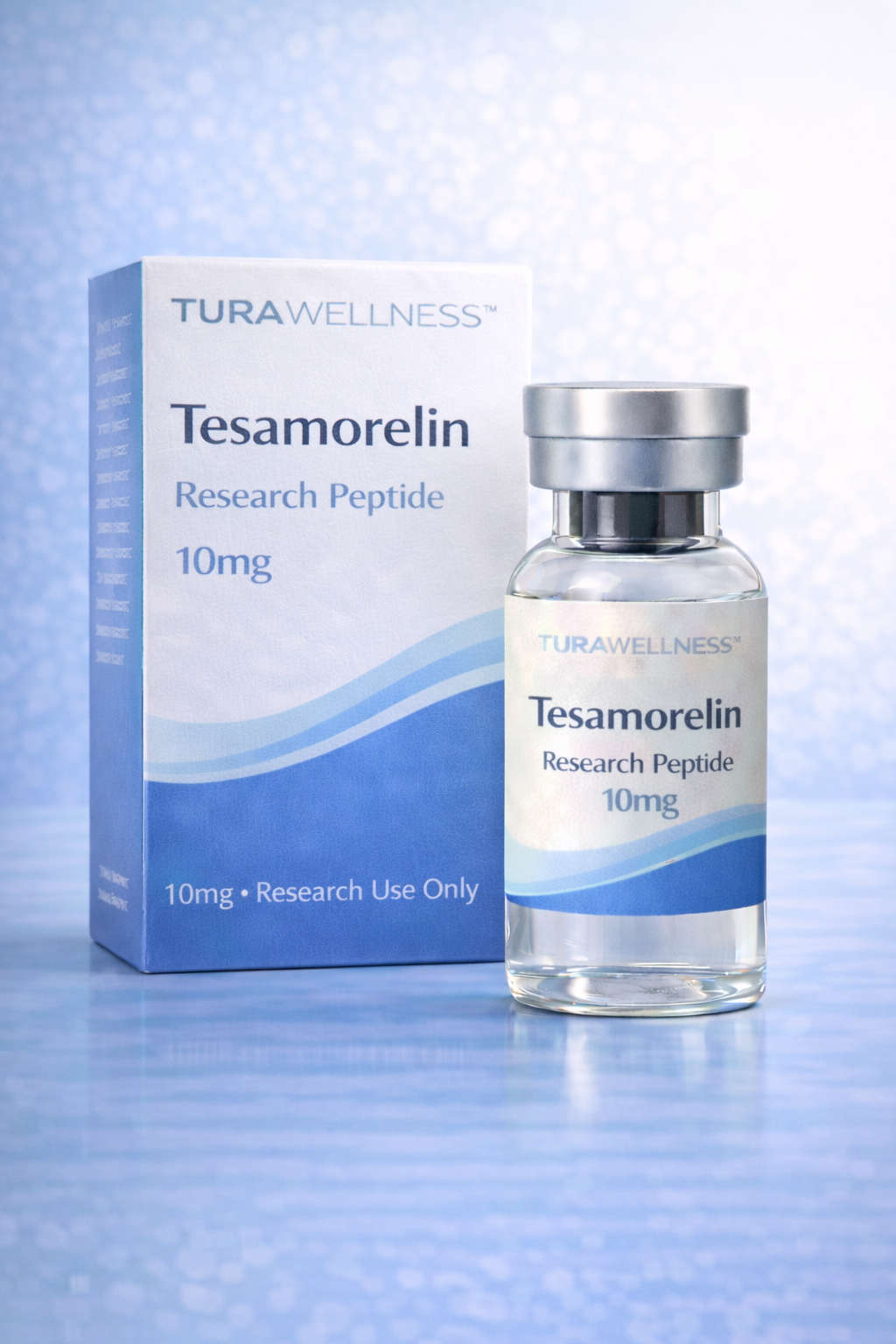
Research Grade Tesamorelin available at turawellness.com
Disclaimer
This guide provides educational information about tesamorelin based on published scientific literature and clinical trial data. This is for educational purposes only and does not constitute medical advice, diagnosis, or treatment. Always consult qualified healthcare professionals before using any peptide or medication.
Tesamorelin is FDA-approved only for the reduction of excess abdominal fat in HIV-infected patients with lipodystrophy. Use for other conditions is off-label and should be medically supervised.
References
1. Falutz J, Potvin D, Mamputu JC, et al. Effects of tesamorelin, a growth hormone-releasing factor, in HIV-infected patients with abdominal fat accumulation: a randomized placebo-controlled trial with a safety extension. J Acquir Immune Defic Syndr. 2010;53(3):311-322.
2. Grunfeld C, Thompson M, Brown SJ, et al. Recombinant human growth hormone to treat HIV-associated adipose redistribution syndrome: 12 week induction and 24-week maintenance therapy. J Acquir Immune Defic Syndr. 2007;45(3):286-297.
3. Stanley TL, Feldpausch MN, Oh J, et al. Effect of tesamorelin on visceral fat and liver fat in HIV-infected patients with abdominal fat accumulation: a randomized clinical trial. JAMA. 2014;312(4):380-389.
4. Stanley TL, Fourman LT, Feldpausch MN, et al. Effects of Tesamorelin on Nonalcoholic Fatty Liver Disease in HIV: A Randomized, Double-Blind, Multicenter Trial. Ann Intern Med. 2019;171(1):1-10.
5. Rochira V, Guaraldi G. Growth hormone deficiency and human immunodeficiency virus. Best Pract Res Clin Endocrinol Metab. 2017;31(1):91-111.
6. Theratechnologies Inc. Egrifta SV (tesamorelin) Prescribing Information. 2024.
7. MedlinePlus. Tesamorelin Injection. U.S. National Library of Medicine. 2024.
8. LiverTox: Clinical and Research Information on Drug-Induced Liver Injury. Tesamorelin. National Institute of Diabetes and Digestive and Kidney Diseases. 2018.
9. Stanley TL, Chen CY, Branch KL, et al. Effects of a growth hormone-releasing hormone analog on endogenous GH pulsatility and insulin sensitivity in healthy older adults. J Clin Endocrinol Metab. 2011;96(1):150-158.